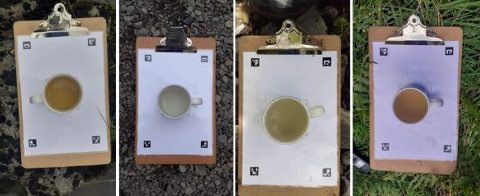
Cup of Carbon: Estimating the Dissolved Organic Carbon (DOC) concentration of water samples with your smartphone
Cup of Carbon is a smartphone-based method for estimating Dissolved Organic Carbon (DOC) concentration in water from its colour. DOC consists of dissolved organic material from plants and animals that has been broken down by microorganisms. DOC concentration is reported as mg/L (milligrams per litre). High DOC concentrations tend to give water a darker colour. Water with high DOC concentrations often flows from catchments with peat-rich soils, and DOC concentration may be influenced by catchment soil type, recent weather (e.g. rain or drought) or disturbance of peat soils.
The Cup of Carbon web app estimates DOC concentration using photographs taken of water samples in a white mug against a white background. The method was developed and calibrated using 117 water samples photographed with 8 smartphone models. In testing, 95% of measurements were within ±12.3 mg/L of laboratory DOC values (Muir et al., 2025).

Equipment
- White-background Cup of Carbon sheet (printed and laminated or placed in a clear plastic sleeve)
- White mug (~300 mL volume; straight-sided; 7-9 cm internal depth
- Clipboard or other flat surface
- Smartphone or digital camera
- Cup of Carbon account
Method
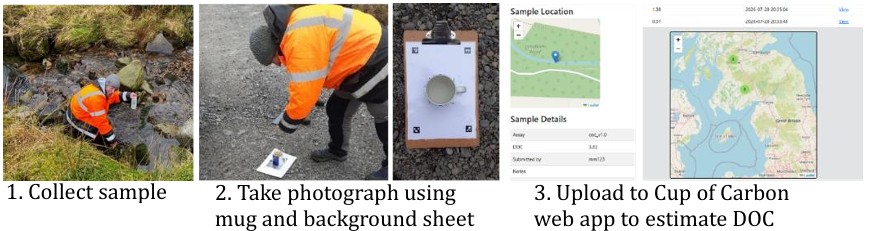
- Print and laminate the Cup of Carbon background sheet
- Fill a suitable white mug with the water sample.
- Place the mug on the background sheet with the handle aligned as indicated.
- Keep the sample in even shade (avoid direct sunlight and glare).
- Log into cupofcarbon.gla.ac.uk and select “Upload”
- Upload a photograph the mug from approximately 30-40 cm above, ensuring the entire background sheet is visible in the image, then click “Submit”.
- If prompted, record the sampling location (GPS or map) and any notes (e.g. weather, sampling time).
Tips for Best Results
- Take photographs in shade or under cloudy conditions.
- Place the background sheet on a flat surface to reduce wrinkles and reflections.
- Take 3-5 replicate photographs and average the DOC results for improved accuracy.
- The method performs best for 0-35 mg/L DOC.
- For very dark samples, dilute with colourless water before analysis.
- Samples containing large amounts of suspended sediment or peat should be filtered, as the method estimates dissolved organic carbon only (not particulate organic carbon